

ROUNDTABLE
Resilient Main Streets
The Role of Social Infrastructure for Climate Preparedness and Adaptation in Montpelier, VT
12:00 noon — 1:00pm
Presenter: Katie Trautz, Executive Director, Montpelier Alive
RESOURCES
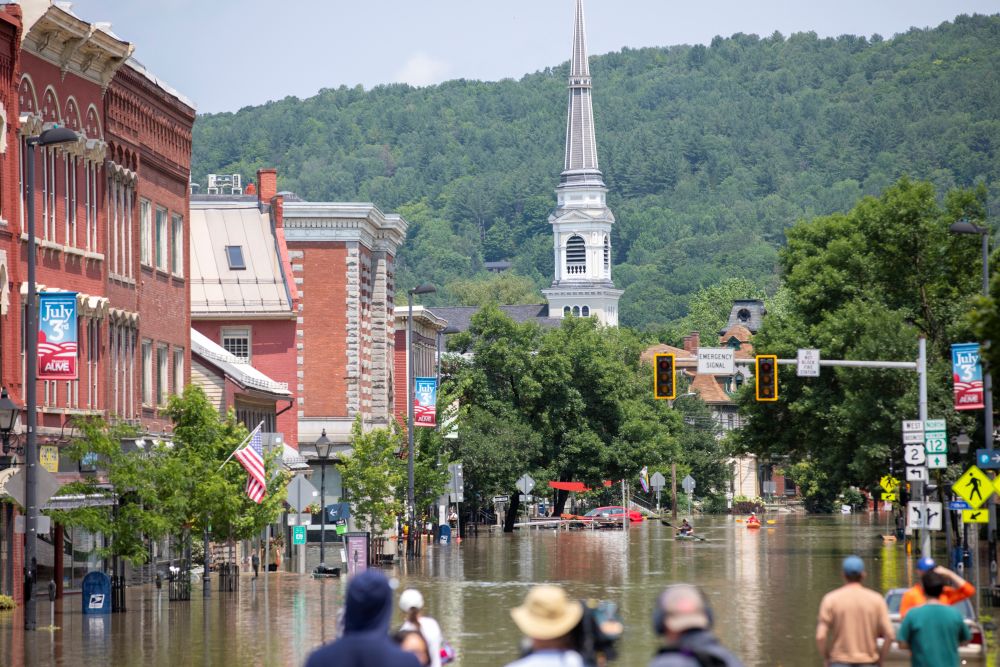
After a day of heavy rains, in the early morning July 11, 2023 the city of Montpellier, VT woke to find itself under water. The businesses of downtown Montpellier were submerged under 5-8ft of toxic water. The catastrophic flood made headlines across the country and around the world as the latest climate disaster, and rang off warning bells here in our small state of Rhode Island marked by its 400 miles of coastline. With water as our defining feature, it’s only a matter of time before our Main Streets contend with similar flooding. But if we prepare by making our Main Streets more resilient now, our Main Streets will ultimately survive and even prosper when our greatest fears are realized.
Within a year, 90% of downtown Montpelier’s 140 businesses impacted by the flood reopened, and the downtown is once again a beloved gathering spot for residents and a favorite destination for tourists — this time prepared for when the next flood hits. How could this be? Montpelier’s speedy response and recovery was possible because they had an operating Main Street Program, Montpelier Alive, that was able to step in to offer leadership at a moment’s notice when it was needed most.
A strong Main Street Program is especially well positioned to lead a Main Street’s climate disaster recovery efforts for several reasons. Perhaps most important is that the core of such programs is the intentional investments made in developing relationships with business owners and community members over time — building trust that’s critical for effective leadership. Well run Main Street Programs are also effective and practiced at volunteer coordination, and as nonprofits can lead necessary fundraising efforts that allow the organization to jump into action at a pace that government entities simply can’t manage.
Key Recommendations to Build the Resiliency of your Main Street
BUILDING PARTNERSHIPS
Effective response to climate disasters relies on the strength of trusted partnerships, and relationship building is at the center of any strong Main Street Program — both with business owners and with the city in the form of public-private partnerships. Building these relationships before disaster strikes is more meaningful than anything, so that in a time of need everyone is able to work together as a team to respond quickly and effectively.
MANAGING VOLUNTEERS
In addition to building relationships with business owners and city officials, it’s also important to build relationships with community members, as it takes everyone working together to respond to a climate disaster. Being seen as a trusted entity by community members before disaster strikes, will give community members confidence in your organization when your leadership is needed most. Disaster response necessitates a large volunteer force, and having some volunteers working regularly with you before a disaster will be a helpful starting place to grow upon when needed.
On the morning of the flood, in coordination with city officials, Montpelier Alive posted a call for volunteers and signup form on their website. As soon as they were able to find higher ground, they started a Volunteer Hub. Over the course of months, over 4,000 volunteers would come through the Volunteer Hub prepared to help in clean-up and rebuilding efforts.
The Volunteer Hub became the central location for:
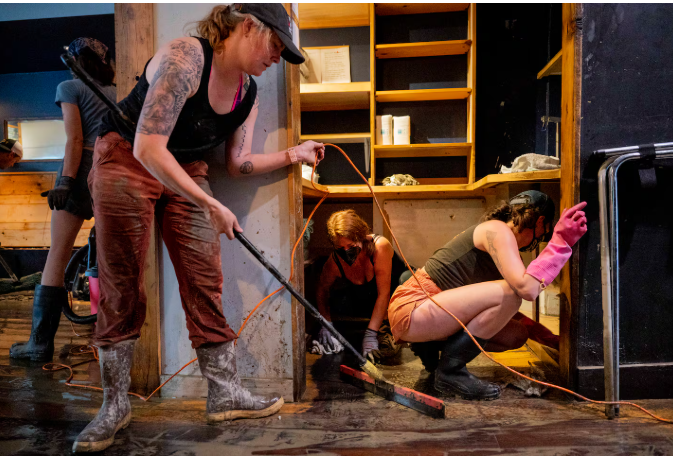
Photo courtesy of Boston Globe, featuring Montpelier VT flood recovery volunteers
- Volunteer Check-In and Coordination
It’s important to have a staff person or volunteer coordinator staffing this table who has a positive energy and is very organized. Central to volunteer coordination was the distribution of clean-up supplies and PPE (personal protective equipment) provided by the local hospital.
-
Donation Center and Food PantryMontpelier immediately began receiving donations ranging from food pantry items and personal care items to furniture for distribution to those in need from the community, region and eventually from across the country.
FUNDRAISING
BUILDING LONG TERM RESILIENCE AND RECOVERY STRATEGIES
-
A series of public forums were held to engage the community in reimagining the future and building consensus around resilience strategies.
-
The multi-stakeholder group Montpelier Commission for Recovery and Resilience was formed to focus on watershed management, flood plain restoration, downtown building assessments (identifying how buildings can become more resilient), and incentive programs for property owners (such as home buyouts etc.)
-
Implementation of business emergency planning workshops and accessible templates for disaster preparedness
DID YOU KNOW? Here in RI we have Ready, Set Rhody!
As part of an effort to protect local cities and towns from the negative impacts of climate change, Gov. McKee and Rhode Island Commerce recently launched a new initiative called “Ready, Set, Rhody.” Under the program, the engineering firm Fuss & O’Neill will help municipal leaders determine how to increase the resilience of commercial districts that are particularly vulnerable to severe weather events, flooding and coastal erosion.
MAINTAINING HOPE
RI’s Climate Change Resources for Businesses
Commerce RI is helping businesses across Rhode Island take steps to address climate change, implement sound resilience practices, and remain competitive and profitable. As part of this effort they've developed several resources for businesses to be resilient against climate disaster. Explore Rhode Island's Climate Change Resource Guides
To Explore Montpelier VT’s Resilience Resources, Visit MontpelierStrong.org