

Asset Mapping: How to Identify Economic Development Assets in Your Main Street
March 5, 2026
12-1PM: ZOOM
The recording of this Roundtable is not being shared due to our use of breakout rooms.
Featuring: Miriam Parson, Main Street America Director of Network Capacity Building, Launch
Mapping Your Main Street District’s Assets
Asset mapping has been used as a community development tool for many different purposes and there are several different approaches. This post explores the use of asset mapping in a Main Street context.
If your goal for your commercial district, village center or downtown is to be economically and socially vibrant, you’re going to need a plan that can be implemented by a group of people over time. While it’s often our inclination to start making that plan by identifying what is needed, what’s missing, or what’s wrong, a better approach is to start with everything that your district does have and then identify the gaps. Doing so leads to better results because when we start with the unique qualities of a particular community, we end up with a plan that builds on what is special and not what might already exist elsewhere.
What is an Asset Map?
Assets are what we want to keep, build upon, and sustain for future generations. When identifying a Main Street district’s assets, consider all aspects of place, including the physical elements as well as people, organizations, programs, traditions, systems, and stories.
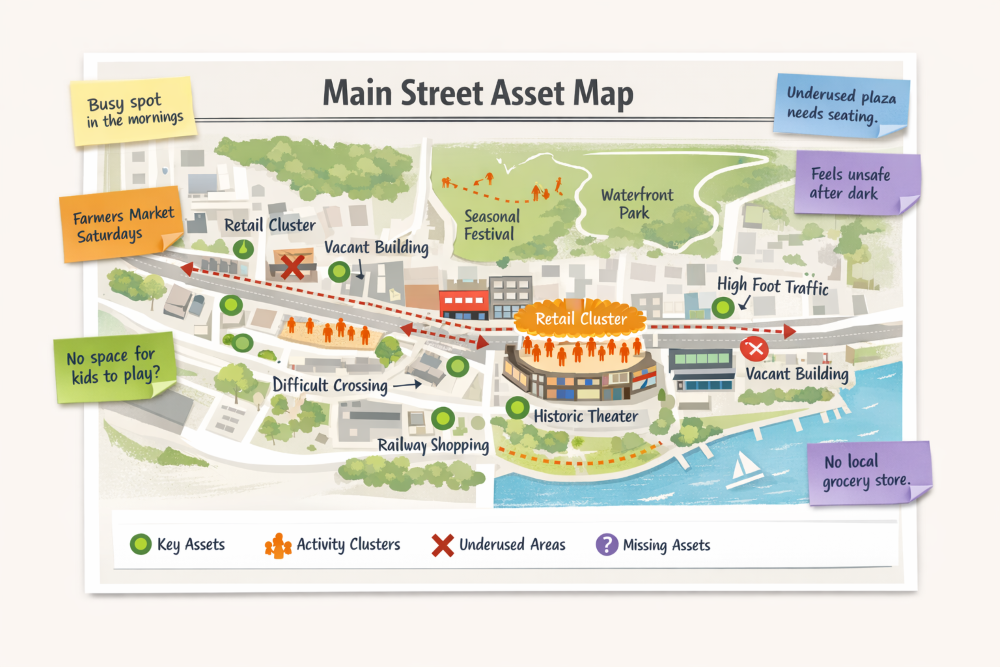
The end result of an asset mapping process might be an actual map (or several!) but more likely it is a collection of documents that together describe all of the strengths of a place and its community. It can be summarized in a written report and it can include one or more lists, maps, charts, graphs, pictures, links, drawings, or other methods of sharing information.
It can be very simple, especially when just starting out. You can always keep a list of what is unknown or what data or information you want to find or research.
One example of a comprehensive asset mapping report from a Main Street District is from the Heart of Ellsworth (Maine.)
However, a report is only a snapshot in time and as a district grows and changes the assets will change as well. Communities should be keeping track of these changing assets, conducting periodic assessments and updates.
What Are You Looking For?
Your reasons for undertaking an asset mapping process will determine what assets you want to identify. For a Main Street District, we are looking for the assets that will lead to the development of all four points of the Main Street Approach (Design, Economic Vitality, Promotion, and Organization) so you can organize your process around those categories. It will also be useful to identify assets that might not be within your district’s boundaries but are nearby and thus impact your district (such as a state park, major employer, etc.)
Main Street Assets in 4 Points
Who Participates in an Asset Mapping Process?
An inclusive approach that actively recruits participation from an entire community is going to result in a more complete asset map. Often it will take extensive outreach to get to everyone, but drawing on the lived experiences and diverse perspectives of those who live, work, and spend time in your community will offer insights that data alone can’t capture. Long time residents and business owners can describe how the district has changed over time and those newer to a community might have fresh perspectives on which spaces and opportunities have been overlooked.
Stakeholders you might want include are:
- Residents (long time and new, of all ages and backgrounds)
- Business and property owners
- Municipal leaders, staff, and boards/commissions (current and former)
- Arts and cultural groups, clubs
- Religious and educational institutions, including libraries

How Do You Do It?
A variety of methods can be used to collect ideas from your community.
- Community meetings/workshops
- Online or paper surveys or asked in person
- Walk audits
- Focus groups
- As a guest speaker at existing meetings
- 1-on-1 conversations
- Review of media or other “literature”
A comprehensive process likely involves multiple occurrences of several of these methods, but you can get started with just one!
What Asset Mapping can do for your Main Street District
Asset Mapping Can:
Best Practices for Asset Mapping Your Main Street
Be Sure To:
From Insight to Action
Asset mapping is most powerful when it leads to action on your Main Street, such as:
- Identifying clusters of activity and reinforcing them through programming or design
- Supporting existing businesses that play key community roles
- Improving connections between assets (like linking transit stops to retail areas)
- Filling gaps where “missing assets” have been identified
- Using maps and community input to inform policy, funding, or development decisions
Visual tools—maps, databases, or even simple guides—can help communicate these insights to local officials, funders, and partners. They make a compelling case: this is not a place defined by need alone, but by opportunity.
See It. Map It. Build From It.
Your Main Street doesn’t need to be reinvented—it just needs to be recognized. By mapping what’s already working, your community can make smarter decisions, invest more effectively, and build on its existing strengths to shape what comes next.
We’ve collected some resources that we hope will help you along your Main Street asset mapping journey, and plan to add to these resources as we learn more.
- Asset-Based Community Development at a Glance, Tamarack Institute
- Asset Based Community Development Institute
- The Four Essential Elements of an Asset-Based Community Development Process, ABCD Institute
- Participatory Asset Mapping Toolkit, from the Community Research Lab
- What is Community Asset Mapping? A Strength-Based Approach to Community Development, Visible Network Labs
- Asset Mapping: User Guide Overview, Institute of Museum and Library Services