
One example of how to structure a collaborative asset mapping workshop for your Main Street
OVERVIEW
This session will help your community understand how your Main Street actually functions—what’s working, what’s underused, and where there are opportunities to strengthen it. To make this exercise as impactful as possible, ensure you have assembled a diverse group of stakeholders including business owners, community leaders, and residents at different stages of their connection to your Main Street, who reflect the full range of experiences, identities, and perspectives in your community.
Full duration of participatory asset design workshop: 2-2.5hrs.
MATERIALS: Large printed maps of the main street district, large post-it notes, small post-it notes, markers, dots.
DOWNLOAD ASSET MAPPING TEMPLATE ORGANIZED AROUND MAIN STREET AMERICA'S 4 POINT APPROACH
AGENDA
Align the group around the goal: understanding how your Main Street works today in order to inform future decisions. Be clear that the approach here is to study the real experience on your main street, rather than just listing places.
Main Street America takes the “Whole Assets Approach” to this work and recommends bundling assets into 5 different categories: natural (such as environment, tree canopy, parks, and water), built (physical things we build including infrastructure), social (the social aspect of living in the community, which may include clubs, social activities, gathering spaces), economic (jobs, large employers, tourism features, and a varied economy that people and communities draw on for their livelihoods), and service (such as health and educational services).
Whatever approach you choose to take in your asset mapping program, remember that you’re mapping use, experience and opportunity – not just inventory.
To avoid groupthink, it’s key to first give space for individual reflection to then be shared and recorded. Ask participants to jot down:
where they go
where people gather
what’s avoided
what’s missing
In groups of 3–5, mark assets, clusters, gaps, and missing elements on a large map. Capture notes about usage and experience.
Instruct each group to mark key assets, identify clusters of activity, flag underused or overlooked spaces, and note missing assets. Encourage notes such as busy at lunch only, or feels unsafe after dark, etc. RI TIP: pay attention to seasonal patterns (summer tourism, winter slowdowns) and RIPTA access.
CONSIDER: getting post-it notes organized by color according to the categories listed above (natural, built, social, economic, service, OR people, places, patterns). This could come in handy later on when you sort and synthesize findings.
Bring everyone back together and ask groups to share key insights.
Have each group share: top assets; key gaps or missing pieces, and one surprising insight.
Leave it to your facilitator to organize and synthesize the feedback in real time. Similar notes should be grouped together. A helpful organizational tool might look like this:
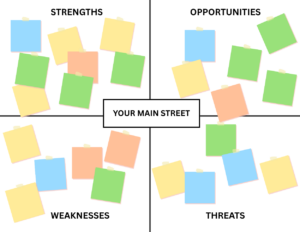
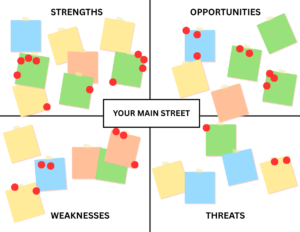
Now guide your group to identify which assets to strengthen and which gaps matter most. You might ask them to vote and give each individual a specified number of dot stickers to note their priorities such as seen here:
Now that you have a clearer picture of the assets and missing assets that matter the most to your group, take a look at feasibility. Map assets on a chart according to the effort (and cost) it would take to make change and impact that the change would have on your Main Street. Do any short term and long term goals become clear? Any low hanging changes that can be planned for today?
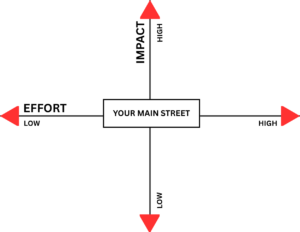 Together, define at least one key takeaway and one short-term action your community can commit to.
Together, define at least one key takeaway and one short-term action your community can commit to. This community guided approach with clear outcomes will leave your participants feeling like valued assets themselves, and will build strong momentum to move your Main Street forward in meaningful ways.