

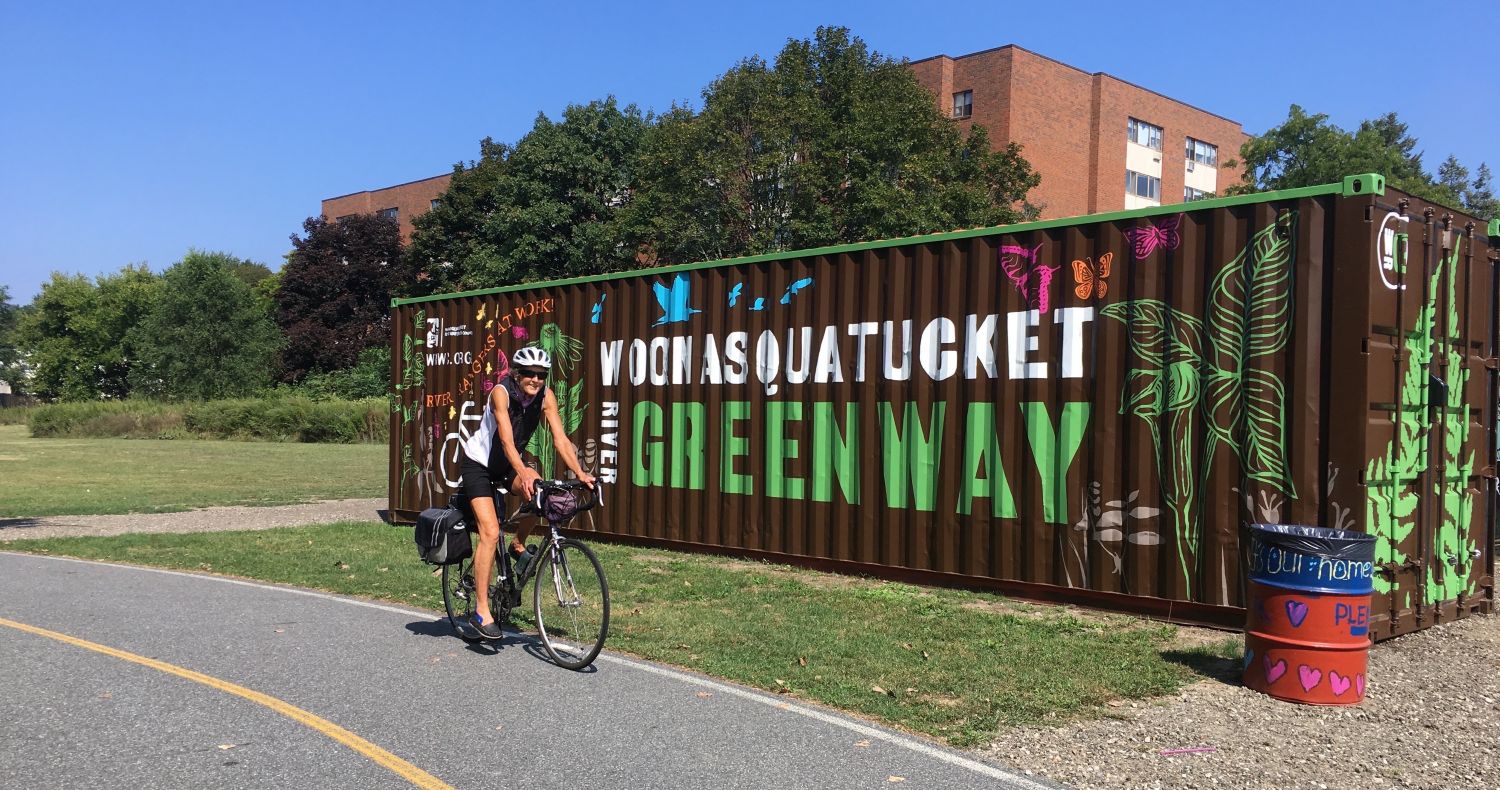
Rhode Island boasts 75 miles of beloved, scenic shared-use biking and walking paths. Advocates want to see far more — access to safe, connected routes in every community in the state.
By Lisa Watts
Affordable options for older adults sorely lacking
Picture this: It’s a warm, sunny day. You feel a breeze on your face and smell salt air as you pedal along a mostly flat bike path, separated from the noise and rush of cars and trucks and surrounded by greenery. You are treated to expansive views of Narragansett Bay and scenic crossings of a few of its feeder rivers and coves. You pass by trailside playgrounds, restaurants, and picnic areas. If you like, you can easily turn off the trail to explore four town centers.
These are among the features cited by the national Rail to Trails Conservancy when it named Rhode Island’s East Bay Bike Path as its January 2025 Trail of the Month, noting “the rail-trail has something for everyone.” Indeed, the 14-mile path connecting India Point Park on the Providence harbor with the seaport of Bristol is well used dawn to dusk by bicycle commuters often heading north to Providence, runners and walkers, and cyclists of all ages and abilities — including small packs of kids heading to school.
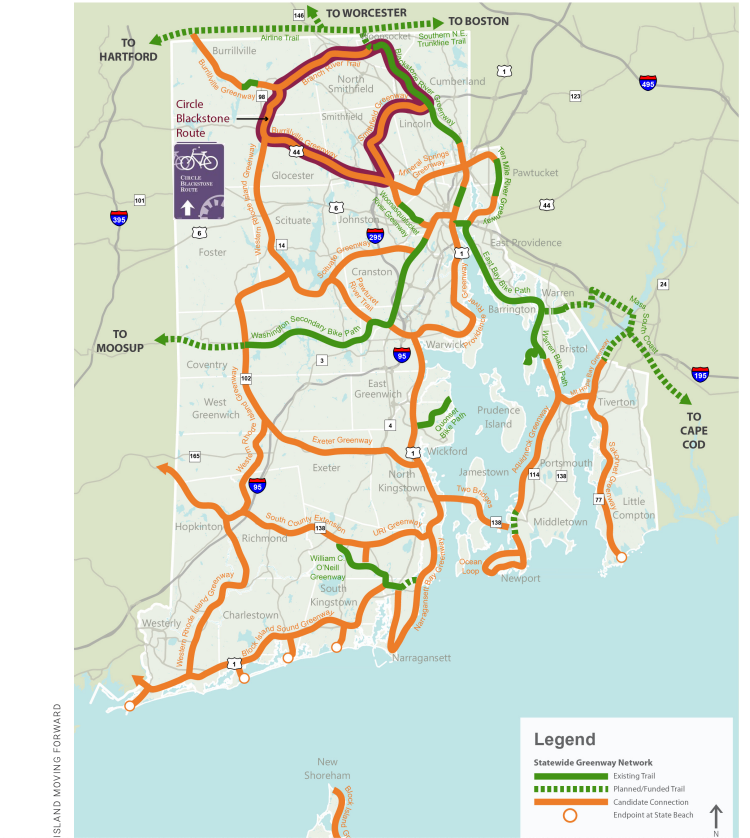
Click the map to expand it!
RI State Greenways Plan Map. Photo courtesy from 2050 Long Range Transportation Plan
As the first rail-trail built in Rhode Island, the East Bay Bike Path is by most accounts the flagship route in the state’s rail-trail portfolio. But each of the longer greenways offers unique features and charms:
- The Washington Secondary Bike Path, named for the abandoned rail corridor, runs 19 miles, following the Pawtuxet River past a few historic mills and under luxurious tree shade between Cranston to western Coventry. The recently repaved path will soon stretch a few more miles to the state line and connect with an extensive trail network in Connecticut.
- The Blackstone River Bikeway’s 18.2 miles includes 11.6 miles of off-road path between Cumberland and Woonsocket and segments of on and off-road bikeway heading south to India Point Park in Providence and north to the Massachusetts border. The path follows the Blackstone River where possible, including on tow paths along the historic Blackstone Canal.
- The South County Bike Path, built on the former Narragansett Pier Railroad, runs 7.8 miles from the Kingston train station past turf fields and the URI campus and through the village of Wakefield to within a mile or so of the shoreline in Narragansett.
In total, Rhode Island is home to 75 miles of completed shared-use paths. The state’s 50-mile share of the 3,000-mile East Coast Greenway, a biking-walking route in development from Key West to Canada, is 67 percent complete, a ratio that many of the ECG’s 14 other states would covet.
Providence resident Eric Weis is a transportation planning project manager with Bowman Consulting. For 18 years he worked for the East Coast Greenway Alliance, including nine years directing greenway development up and down the East Coast. Ten years ago he shifted into active transportation projects focused mostly on Rhode Island. “When it comes to shared-use paths,” Weis says, “Rhode Island punches way above its weight,” given its relatively small size and population.
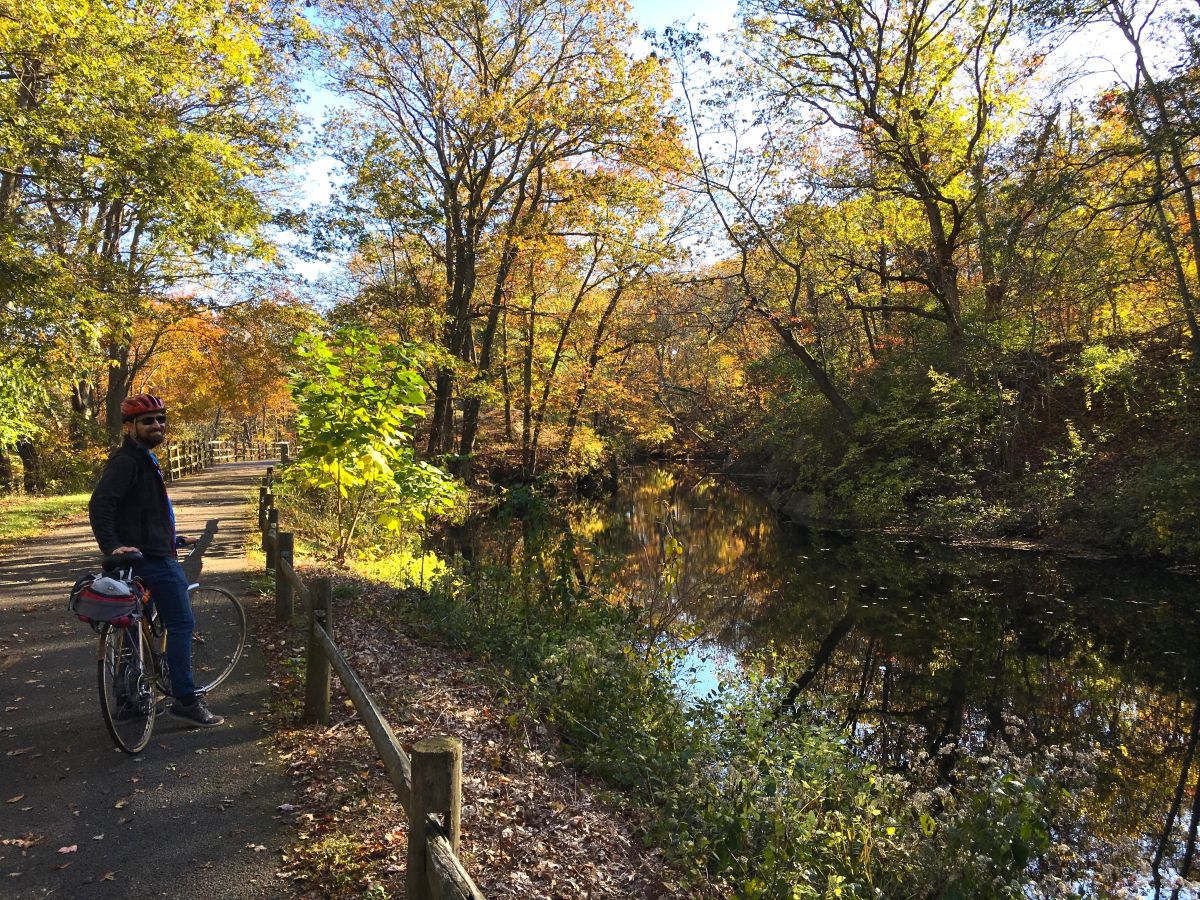
Blackstone River Bikeway. Photo courtesy of Caroline Stevens
Beyond the low-hanging fruit
Progress has slowed, however, on the Ocean State’s biking and walking landscape in the last decade, Weis warns, while neighboring Connecticut and Massachusetts are stepping up their investment in such projects. Except for the last five miles of the Washington Secondary Trail, due for completion in the next few years, Rhode Island has “built out the low-hanging fruit,” the rail line right-of-ways that can be converted to trails, Weis notes. The work that remains to connect more communities across the state involves acquiring more challenging — and more expensive — right of ways.
The cost, time, and negotiation required to build greenways might surprise most greenway users. On average, a high-quality urban path costs $1 million per mile to build, and much more if the segments involve bridges or multiple road crossings. And resistance to their development persists despite plenty of successful examples such as the East Bay Bike Path (EBBP) that showcase the economic, transportation, social, and health benefits that greenways bring to communities.
The EBBP’s development offers a textbook case. In 1980 State Rep. Thomas Byrnes of Bristol submitted a bill to study the conversion of the rail corridor, which was purchased a few years earlier by the state’s Department of Transportation (RIDOT), into Rhode Island’s first multi-town bike path. In the midst of the oil crisis, Byrnes cited the energy-saving benefits of bicycle transportation. Community members along the route opposed the bike path idea, believing it would attract crime, hurt property values, and waste taxpayer money. But Byrnes had the support of then-Gov. Joseph Garrahy and Edward Wood, then director of RIDOT and an environmental advocate. Construction began in 1986 and was completed in four phases, with the final stretch opening in 1992.
“Now of course people who live along the bike path boast about it and it’s become a main selling feature when houses are listed,” says John Flaherty, a Grow Smart RI senior adviser and member of the state’s Transportation Advisory Committee, which advises the State Planning Council on transportation issues and encourages public involvement in the planning process.
Funding shared-use paths almost always feels like an uphill battle. Biking and walking paths and protected lanes “are never seen as integral, normal civic projects,” says Weis. “They are always funded through some special channel, even for maintenance. If an arterial road needs to get rebuilt for commuters, it’s funded from the DOT budget. But to build a shared-use path, that funding traditionally comes through federal earmarks or federal grants.”
Bob Billington knows first-hand the struggle to fund bike paths. In 1985 he founded the Blackstone Valley Tourism Council to bring focus to the region and restore its ravaged environment and economy. “As the birthplace of the Industrial Revolution, the Blackstone Valley took America from bankruptcy after the American Revolution to the super-power status that we hold today,” he says. When the textile and other mill industries moved south, the valley was left with polluted land and rivers and economic depression. Seeking to revitalize the region while telling its story, Billington introduced sustainable tourism — including the creation of a 48-mile Blackstone Valley Bikeway, a project he spurred on by securing $15 million in federal funding two decades ago.
Now in its fifth decade of development, the bikeway is a little more than halfway complete. “The bikeway got people to rally around it. People use it and love it,” says Billington, who recently retired after 40 years of heading the tourism council. “Now we have to complete the work. Funding is our biggest challenge.”
Beyond recreation
As laid out in the vision statement of the Statewide Bicycle Mobility Plan, adopted in December 2020, “the future of bicycling in Rhode Island lies in the state’s ability to promote bicycling for everyday transportation…[with] the need to plan for well-connected, low-stress bikeways in urban, suburban, and rural areas.” Or, as Flaherty says, prioritize paths where they can connect people to destinations where biking can replace car trips. Encouraging more users to bike to work or for errands is simple, he says: Make it safe for everyone to bike.
Agrees Billington: “We have to get serious as a state that we want to connect all four corners of our state by these pathways.”
In earlier years Ocean State bicycle advocates found support from elected officials, especially from Gov. Lincoln Almond (1995-2003) and Senators John Chafee (1976- 1999) and Claiborne Pell (1961-1997). The climate changed more recently. In 2015, then Gov. Gina Raimundo appointed Peter Alviti Jr., to lead RIDOT. Alviti saw repairing the state’s highway bridges as his mandate. He viewed bicycle and pedestrian infrastructure needs as a distraction, bike advocates say, and as competition for funding. In 2019 Alviti made the controversial move of taking $19 million in federal funding for pedestrian and bicycle safety and redirected it to address cost overruns on the Route 6/10 interchange project in downtown Providence.
Alviti’s retirement in late February 2026 and the November 2026 gubernatorial election present an inflection point for bike and pedestrian advocacy. “We just don’t know what the future holds,” Flaherty says. Robert Rocchio is serving as interim RIDOT director; a permanent replacement likely won’t be named until voters choose the next governor.
Dreaming of a safer, more connected future
After doing this work for 28 years, Weis can vouch for the patience it takes to see a route through from concept to paved path. “Being a trail advocate or professional isn’t a good career for people who need a quick return on investment,” he says. As a colleague once told him, “bicycle-pedestrian advocacy is a 12-step program for optimists.”
If they could wave a magic wand and speed up a few project timelines, here’s what three biking and walking planners want to happen in the next 10 years:
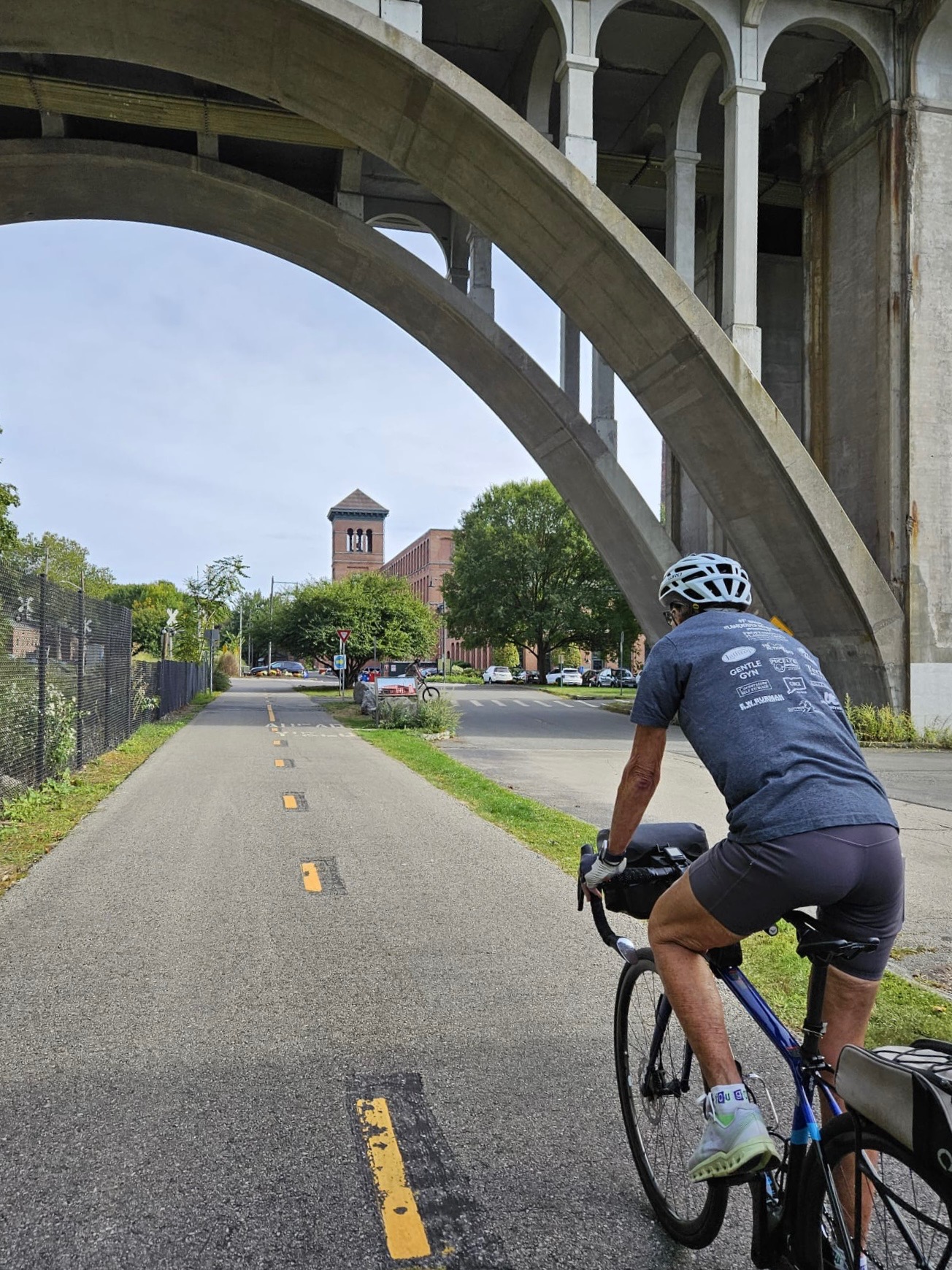
Biking under the Route 116 Viaduct. Photo courtesy of Deirdre Bird
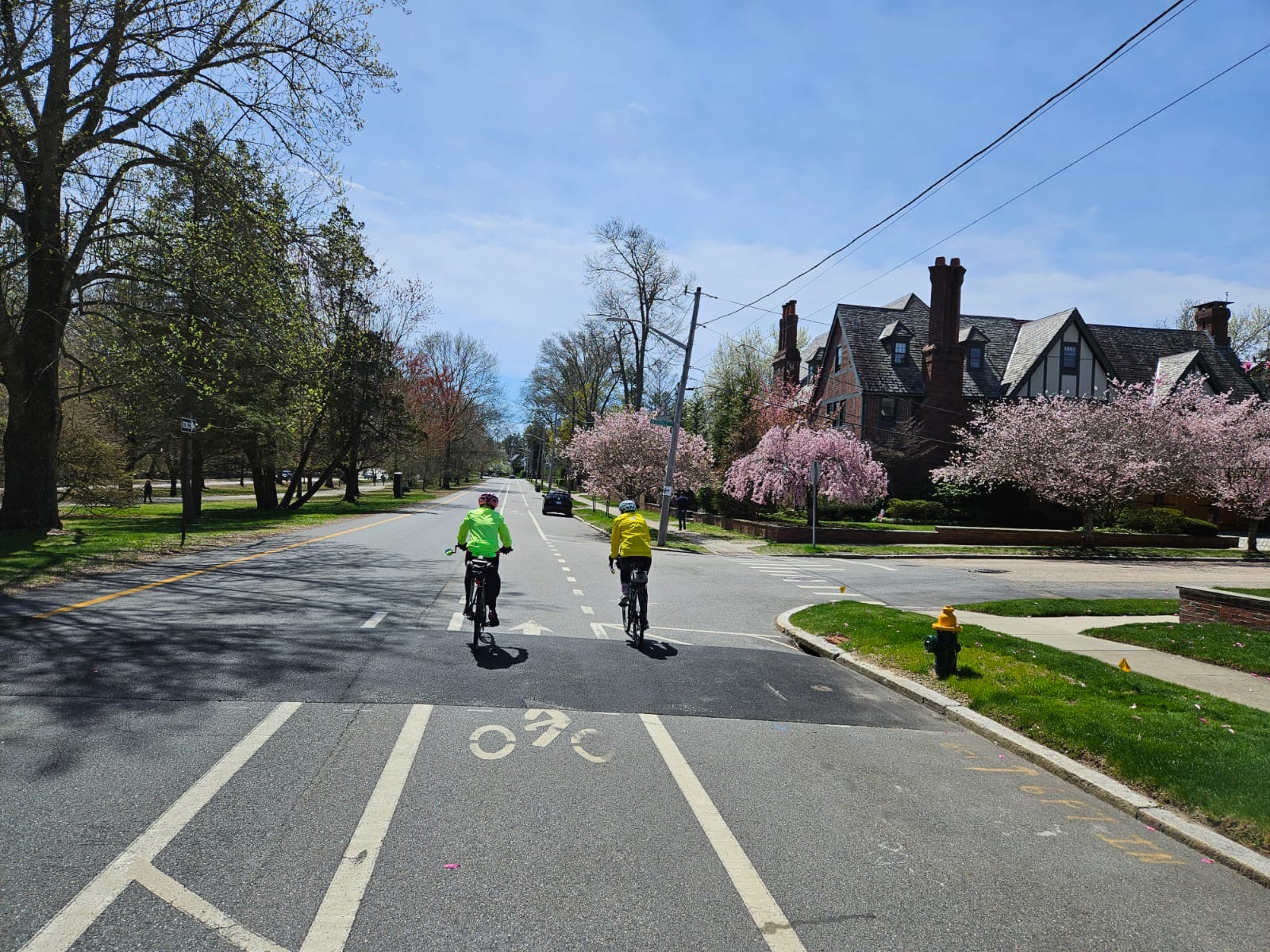
Blackstone Boulevard Bike Lanes. Photo courtesy of Deirdre Bird
Weis wants to see progress in the state’s most populated areas, including a safe, traffic-separated connection between the northern end of the Washington Secondary Trail and downtown Providence (“I’m very optimistic about this,” he says). He also wants to see more separated bike lanes with sidewalks alongside them, separating pedestrians, bikes, and motor vehicles. “I believe the future of shared-use paths isn’t necessarily the 12-foot separated greenway. It’s side paths alongside roadways with wide rights of way. There’s a lot more opportunity for that type of infrastructure, and the farther you can get bikes away from cars, the lower the level of stress.”
Flaherty hopes for the implementation of a rail-with-trail multimodal corridor along the Newport Secondary Line, a project that would connect walkers, cyclists, and rail passengers from Newport, Middletown, and Portsmouth on Aquidneck Island and on to Tiverton and Fall River (which now has connecting rail service to Boston). “This has been studied for many years, is part of each community’s Comprehensive Community Plan, and is now getting renewed attention,” he says. The state’s recently updated Long Range Transportation Plan, “Moving Forward RI 2050,” calls for replacing the former railroad bridge connecting Portsmouth and Tiverton.
Billington simply wants to see the state’s bicycle mobility plan completed in the next ten years, maybe half of it over the next five years. “That takes political will and funding,” he says. “These are legitimate transportation amenities that all sectors of our society use. It makes no difference who you are, the pathways bring people together to enjoy our state’s natural, commercial, and environmental resources. [Shared-use paths have] become the resource we are best known for and our most enjoyed resource.”
Resources for biking and walking advocacy in Rhode Island
- BikeNewport – Aquidneck Island nonprofit working to make bicycling accessible, safe, and inviting for all.
- Guide to the East Coast Greenway: New Haven, Connecticut, to Providence, Rhode Island By Bike or On Foot — A newly updated guide from the East Coast Greenway Alliance that highlights history, culture, and places to eat and sleep along the southern New England stretch of the Key West to Canada East Coast Greenway.
- Paths to Progress – Statewide network of cycling advocates working together to complete and plan future bikeways in Rhode Island and advocate for funding to complete them..
- PVD Streets Coalition – An alliance of 42 community organizations, local businesses, schools, neighborhood associations, and thousands of engaged individuals advocating for people-friendly streets in Providence.
- Woonasquatucket River Watershed Council — Nonprofit working to spark economic development by restoring the Woonasquatucket River and communities around it and by enhancing, extending, and bringing people to the Woonasquatucket River Greenway.