

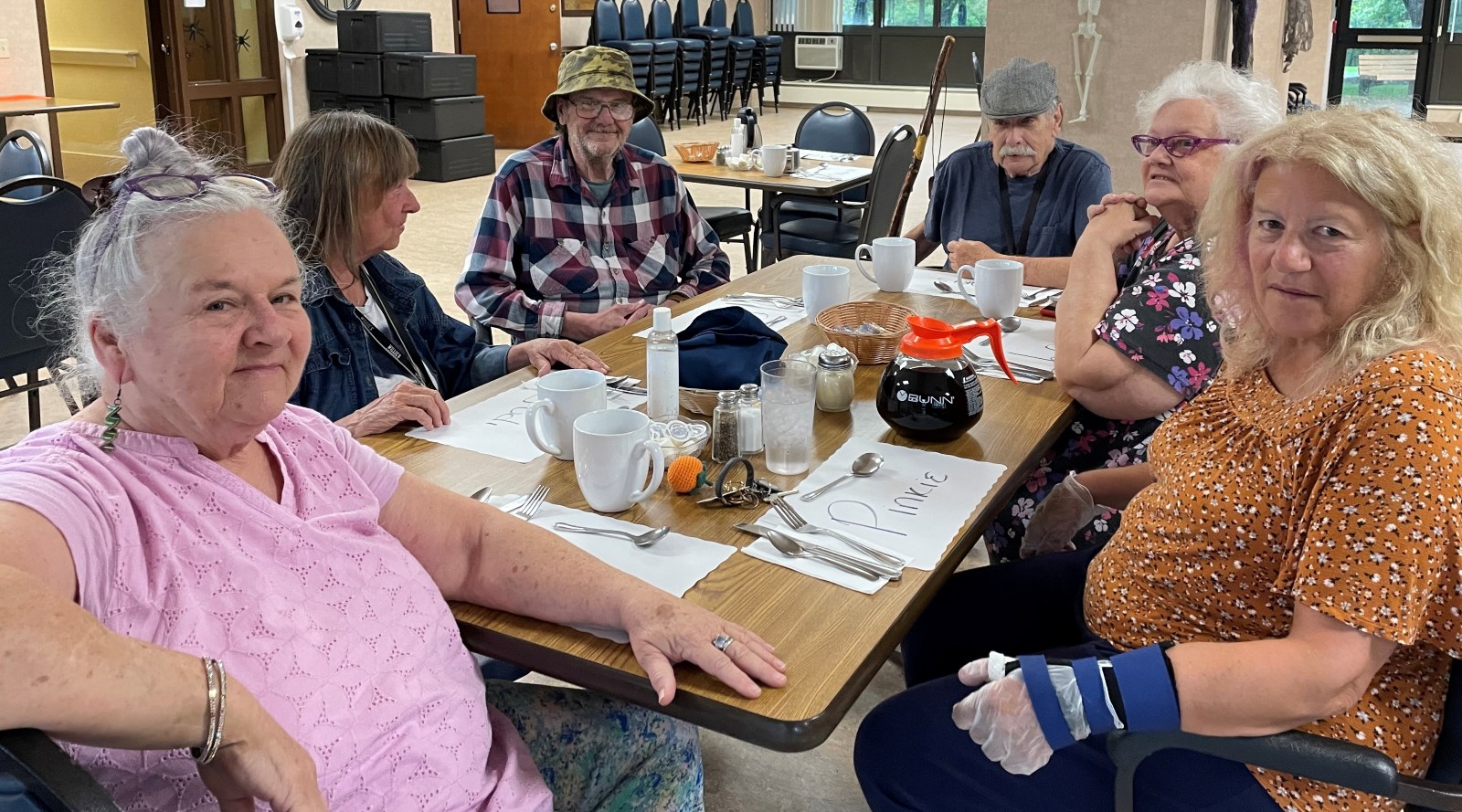
The self-dubbed “Team Table 3” gather for lunch at Shalom Apartments in Warwick (from left): June Perry, Judi Case, Rick Kinney, Chris Young, Lois Clemens, Joanne “Pinkie” Gianfraccio.
Can Older Rhode Islanders Find Affordable Housing and a Sense of Community?
By Lisa Watts
It’s nearly lunchtime at Shalom Apartments in Warwick. Lois Clemens and her friends, some pushing walkers, are gathering at their table. Their building’s spacious community room is decorated sparingly with a few harvest pumpkins and Halloween skeletons. While Joanne “Pinkie” Gianfraccio pours glasses of ice water and cups of decaf to pass around, the four women and two men rib each other and critique the musical performance they attended last night in the other half of this room.
Clemens, 78, moved into her Shalom apartment seven years ago after renting rooms in several private homes. The building, operated by the nonprofit Jewish Collaborative Services, offers one- and two-bedroom independent living apartments for adults aged 62 and older. Those who qualify for financial assistance—as Clemens does, living solely on her Social Security checks—pay 30 percent of their income for rent.
Residents can pay a $3 donation for the daily hot lunch. On her first day of joining the lunch program, Clemens was seated (“there’s a lunch lady assigning your seats,” she quips, “like they do in kindergarten”) next to a 94-year-old woman. The two women stayed friends until the seatmate’s recent death at 100. When Chris Young, a former lawyer and history buff, joined Clemens’ table a few years ago, things really picked up. He dubbed their group of lighthearted lunch mates as Team Table 3. “Chris is a joiner, he’s a facilitator,” Clemens says, so he initiates outings and occasions such as Team Table 3 picnics.
Her apartment is fairly basic—a living room, bedroom, and small kitchen area “without much counter and cabinet space and no dishwasher,” she laments. She is friendly with her fellow hall mates. “It’s gotten to be like a dorm for us,” Clemens says. “If two of us come out of our doors at the same time, we start a conversation.” After her recent surgery, hallmates pitched in to help with her cat and meals. In turn she drives people to appointments or loans them her car. “Sometimes while I’m trying to bring my walker through my door, my cat escapes and prances up and down the hall,” she admits. “Everybody on our floor loves her.”
“If it’s 20 below in the winter and you need a cup of sugar, you don’t have to put your boots on and go out in the cold. I can go down the hall in my bare feet and knock on a neighbor’s door,” Clemens says. “I just really don’t get why people want to stay in their homes until they die. It’s so isolating.”
Affordable options for older adults sorely lacking
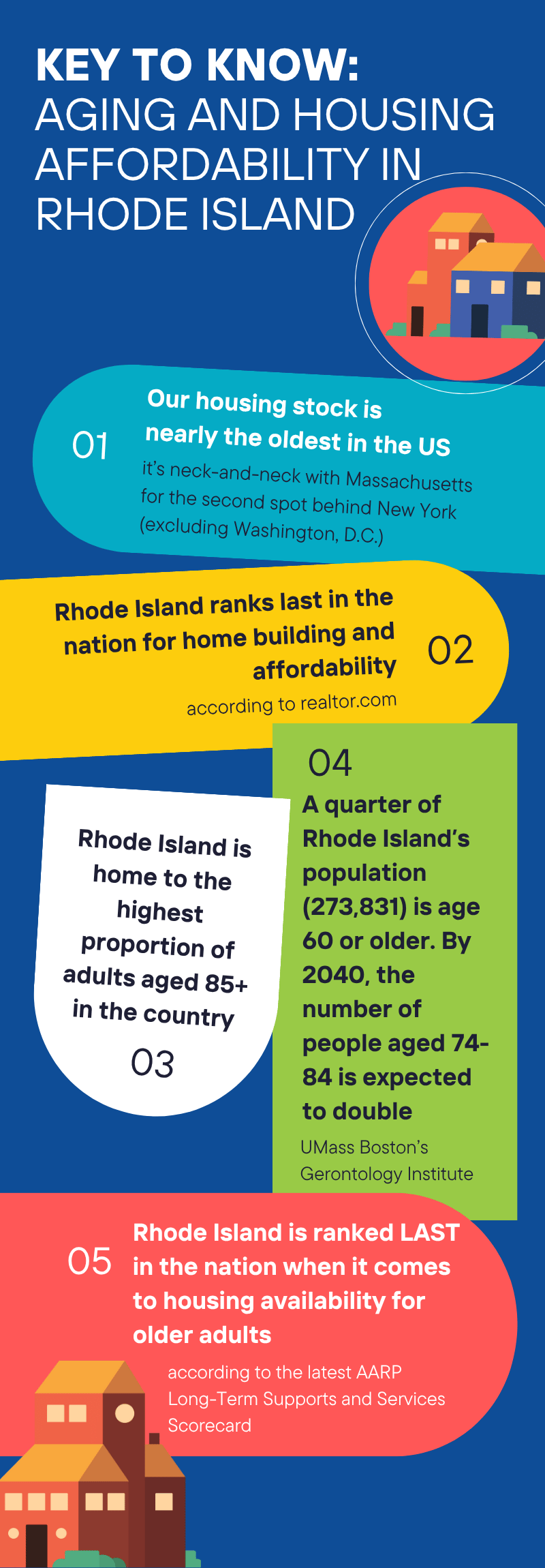
Clemens is right: Plenty of older adults say they don’t want to leave the comfort and familiarity of their homes as they age. But many older Rhode Islanders would downsize to more economical, accessible independent-living options such as Shalom Apartments if more options were available, as Catherine Taylor, AARP Rhode Island state director, noted in a 2024 Providence Journal opinion piece, “Aging with Dignity: Housing Choices for Rhode Island’s Older Population.” The latest AARP Long-Term Supports and Services Scorecard, Taylor wrote, “ranked Rhode Island 51st in the nation—dead last when it comes to housing availability for older adults.”
It’s one of many housing superlatives that Rhode Island can claim that aren’t exactly the stuff of marketing brochures. Ours is the second most densely populated state behind New Jersey. Our housing stock is nearly the oldest in the United States, neck-and-neck with Massachusetts for the second spot behind New York (excluding Washington, D.C.). Meanwhile we rank last in the nation for homebuilding and affordability according to Realtor.com, with rents rising sharply and median home prices making ownership out of reach for many.
At the same time, Ocean Staters are aging. Rhode Island is home to the highest proportion of adults aged 85-plus in the country, according to the Rhode Island Healthy Aging Data Report, compiled by researchers at UMass Boston’s Gerontology Institute. A quarter of Rhode Island’s population (273,831) is age 60 or older. By 2040, the number of people aged 74-84 is expected to double.
Part of the disconnect for aging Baby Boomers, the last of whom will turn 65 in 2029, is that many of them have enjoyed a relatively healthy economy their whole lives, thanks to post-World War II policies and programs that no longer exist, notes Annette Bourne, research and policy director at HousingWorks RI. The research center and information clearinghouse at Roger Williams University studies the relationship between housing and the state’s economic future and residents’ well-being.
“It’s hard to make people [60 and older] understand that [they] grew up in a particularly beneficial time economically in the U.S.,” Bourne says. “Huge government subsidies went into building highways and roads and creating suburbs, while a housing finance system enabled many of our parents to buy the classic ‘starter home’ for an affordable price. The anticipation among this age group is that all of this economic stability is supposed to continue as the norm.”
During a brief window of time after COVID-19, federal subsidies for building older adult housing were available. These days, federal policies seem to favor workforce and family housing, says Christian Belden. He serves as executive director of Church Community Housing Corporation (CCHC), a nonprofit based in Newport County dedicated to helping low- and moderate income Rhode Islanders live in “safe, decent, affordable housing and neighborhoods,” according to the CCHC mission. The nonprofit has created close to 400 affordable units for older adults between developments in Newport, Middletown, Portsmouth, and North Kingstown over the last six decades. Some of those projects have involved retrofitting existing buildings; others were new construction.
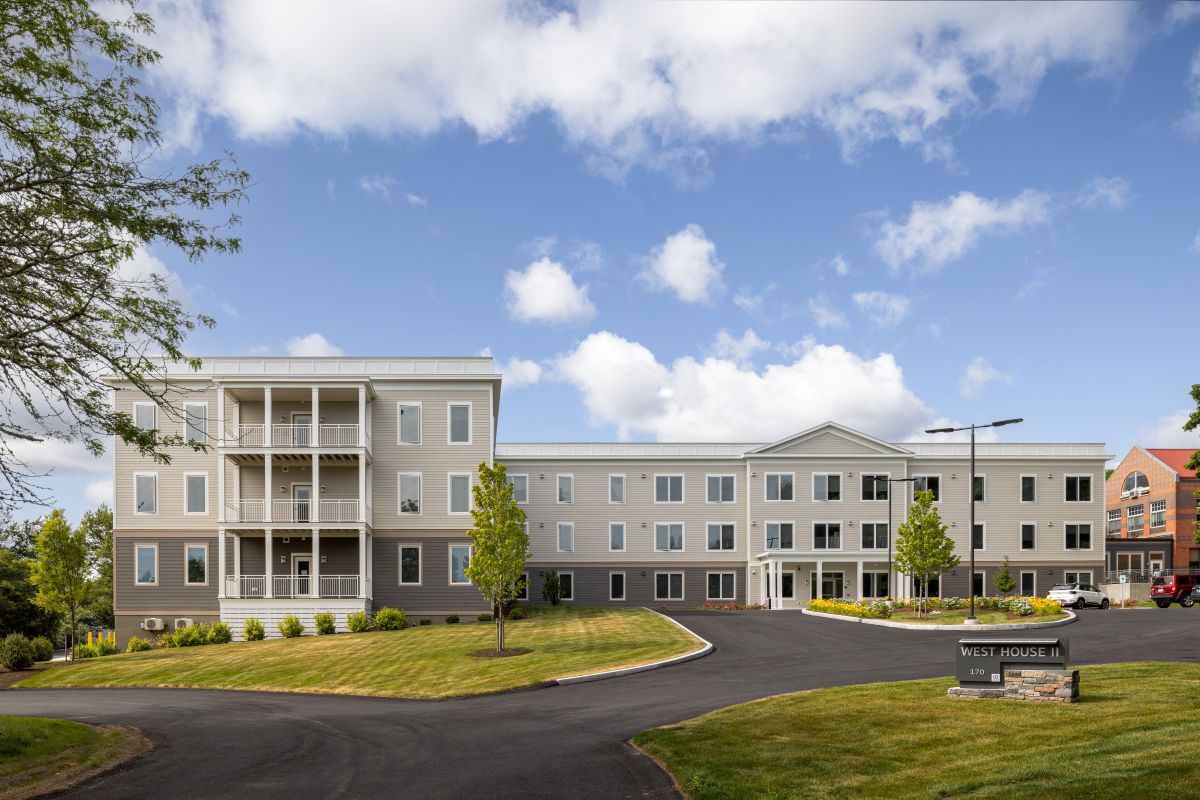
Pictured: West House II, a Church Community Housing Corp project in Middletown, RI designed by Union. Photo courtesy of Gray Photo LLC
“In the last two years alone, we’ve added 108 units of senior affordable housing between Middletown and Portsmouth, which should provide some optimism,” Belden says. “But that optimism should be tempered with the fact that we had an unusually robust funding environment post-COVID because of stimulus act funding, funding that seems to have peaked.”
NIMBY pushback
Shifting funding policies aren’t the only hurdles contributing to the housing crisis. Land and construction costs have risen quickly. Restrictive zoning along with local opposition to affordable developments have also grown. Residents fear the impact of a growing population on roads, schools, and more—not to mention wanting to save forested land and protect air and water quality.
Belden knows the NIMBY (Not In My Backyard) mindset all too well. “Pushback is everywhere,” he says. He has seen conspiracy theorists claim that a development won’t really be for older adults, that it will become general so-called “Section 8” housing, named for the U.S. Housing and Urban Development’s (HUD) Housing Choice Voucher Program that helps low-income families, elderly persons, veterans, and disabled individuals afford housing in the private market.
“I tell people, ‘Come with me, let me show you the senior housing we’ve built. I’ll give you a tour, you can hear from the residents.’ But no one has ever taken me up on my offer,” Belden says.
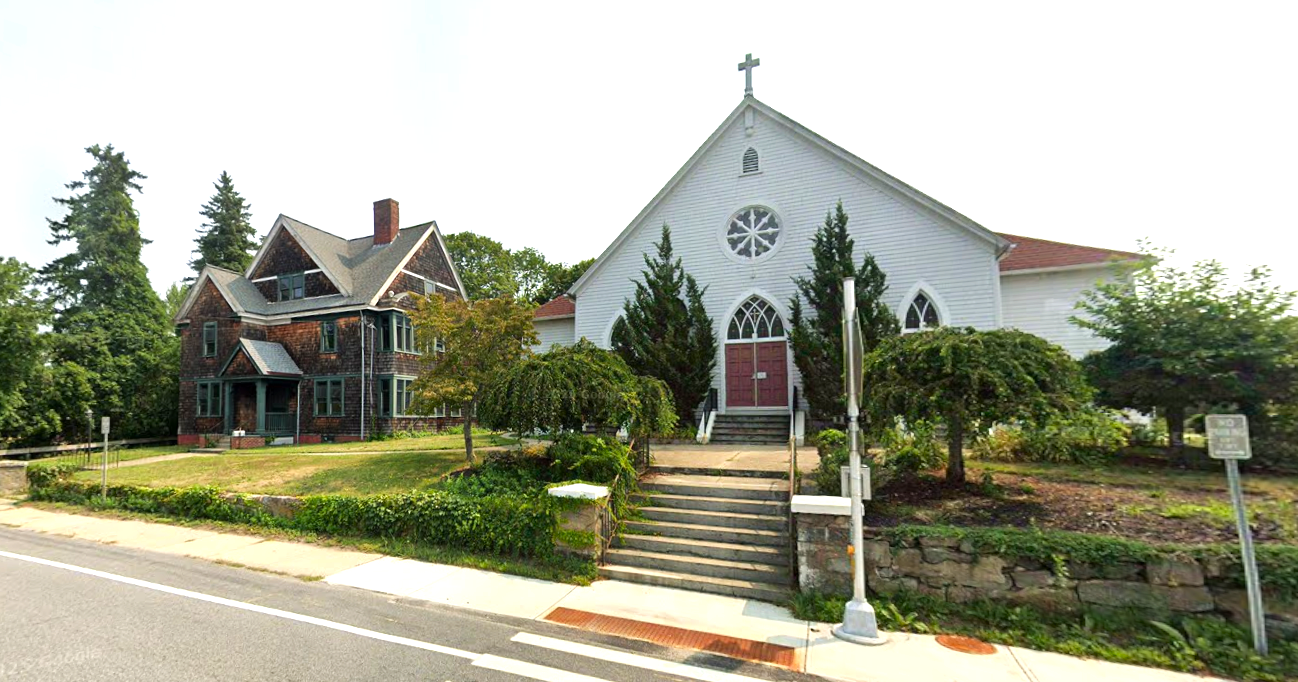
Belleville House in North Kingstown
One successful CCHC project for older adults, Belleville House in North Kingstown, began as a project—with HUD funding—to retrofit a Little Compton restaurant into 20 units for older adults. Little Compton currently offers nine long-term affordable housing units; a state law requires that at least 10 percent of each R.I. municipality’s housing be affordable. When abutting residents successfully opposed the development, CCHC pivoted to North Kingstown and the former St. Bernard’s church and rectory on Tower Hill Road. The older building sat empty after the church’s move to new quarters up the road.
Belleville House now offers 35 age-restricted, affordable housing units, completed in two phases in 2012 and 2014. A community room features a large kitchen and the original stained glass windows. The $7.9 million project was a public-private collaboration between CCHC, Washington County Community Development Corporation (now defunct), HUD, the Rhode Island Housing Resources Commission, RIHousing, and town officials. As with Shalom Apartments, residents pay 30 percent of their adjusted monthly income for rent, which includes utilities and use of the community spaces.
Opportunities for optimism
Funding more private-public partnerships to build complexes like Shalom Apartments—and encouraging communities to welcome them—is one tactic for increasing affordable housing units for older adults. But it’s not the only one. Housing experts say that some of the things that make Rhode Island unique could also point to new solutions for housing, for older adults and all ages. Those options include:
-
More retrofits and reuse of empty mills and shopping centers.
Rhode Island has an ample supply of historic industrial buildings and other commercial spaces that are “ripe for rehabilitation and renovation,” as HousingWorks RI noted in its 2024 report.
-
Supporting “granny flats.”
As of January 1, 2024, a statewide law mandates that Rhode Island municipalities allow accessory dwelling units, or ADUs, to be built on their property under certain conditions, helping to expand affordable housing options and accommodate multigenerational living. Older homeowners could move into an ADU and rent out the larger house or offer it to children or grandchildren (two generations facing the financial crush of rising housing costs); family caregivers could offer their parents a place to maintain their independence while also receiving any help they may need; and older residents could rent an ADU from another homeowner so they can stay in the community they know.
-
More services to encourage multi-generational roommates.
Nesterly, a home-sharing website, is connecting two generations of Boston-area residents with compatible needs: older people who want to stay in their homes but need help, and younger people who need an affordable place to live. Nesterly conducts background checks and offers a payment platform along with ongoing support. Such solutions could address not just the housing shortage but also a social challenge increasingly plaguing all ages: loneliness.
-
More Baby Boomers who can devise new solutions.
As the UMass Boston researchers write in the 2025 Healthy Aging Data Report for the state, “The growing older population is more diverse and more educated than the population was in our 2020 Rhode Island report. Rhode Island is a state bursting with potential to benefit from the gains in human longevity and the opportunities it presents.”