
The lessons shared below come to us thanks to an informative Main Street RI Roundtable:
Parking – PART 2: Can Parking Reform Save our Downtowns?
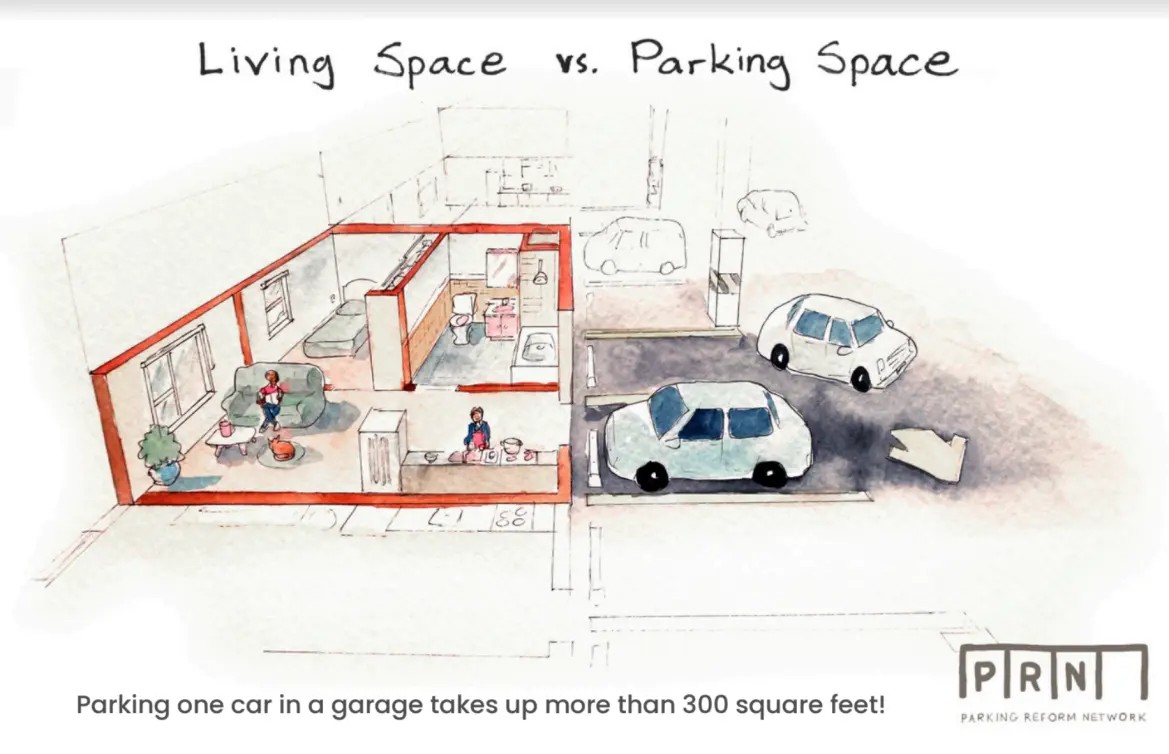
credit: Parking Reform Network
At a recent Main Street Rhode Island Roundtable, we were joined by Kevin Lowther—a housing advocate, former Westerly town councilor, and Roger Williams University law student—for a conversation about something every downtown struggles with: parking.
His central message was simple:
Rhode Island communities systematically overbuild parking—and it’s holding our Main Streets back.
The Real Cost of “Free” Parking
In a small, built-out state like Rhode Island, land is limited. Every surface parking lot represents a choice. When zoning codes require large amounts of off-street parking:
There’s an Economic Toll: Mandated parking spaces divert money that could instead increase housing density, add units, or provide better amenities in new developments
Limited Land is Wasted: In a small, dense state like Rhode Island, surface parking consumes land that could support housing, commercial uses, or other productive activities.
The Environment is Harmed: Large expanses of impermeable asphalt increase stormwater runoff and create urban heat islands, degrading environmental and public health conditions.
Quality of Life is Decreased: Land taken up largely by parking makes takes a strain on walkability, increases traffic congestion, and reduces the vitality of Main Streets.
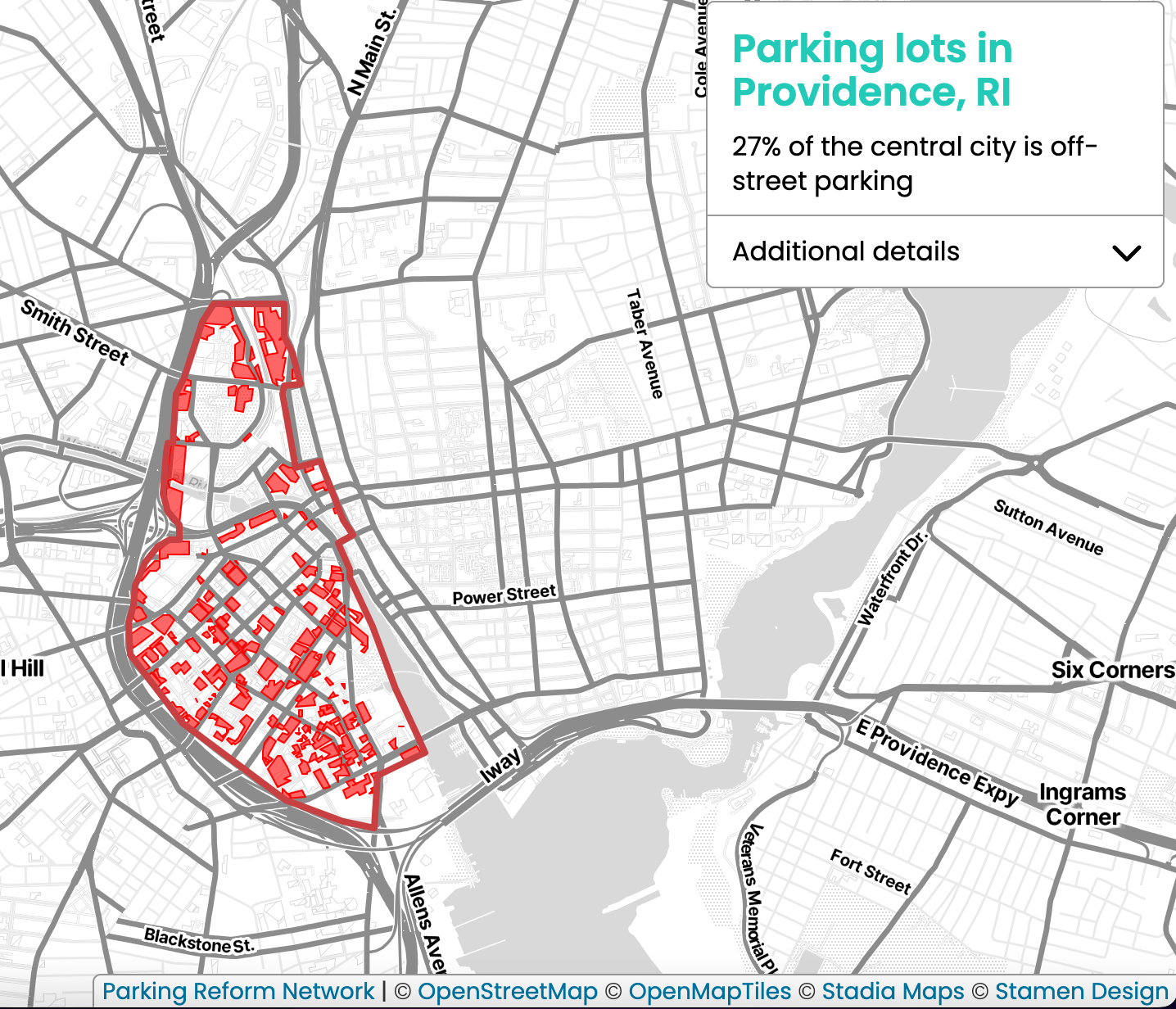
DID YOU KNOW? 27% of downtown Providence is off-street parking lots. If on-street parking were included, the share of land devoted to parking could rise to around 40%.
Parking isn’t neutral infrastructure. It shapes development patterns. In a dense state, land devoted to parking is land that cannot support housing, storefronts, or public space.
What Are Parking Minimums?
Most municipalities require developers to build a minimum number of off-street parking spaces for new housing or commercial uses. Common examples include:
- Two spaces per residential unit.
- One space per 3–5 restaurant seats.
- One space per set amount of commercial square footage.
Many of these standards were written decades ago—before remote work, rideshare apps, and shifting travel patterns. Yet they remain embedded in zoning codes and often lack clear, evidence-based justification. We’ve seen again and again what this results in: auto-oriented development and barriers for small-scale businesses that may not actually need large parking lots.
Forward Thinking: a New Proposal for Parking
Kevin and fellow RWU student Casey Rivera drafted legislation through the Housing Policy Lab, and adopted by Neighbors Welcome RI, that would:
- Reduce parking minimums for single-family, multifamily, and commercial development.
- Eliminate minimums for affordable housing, senior housing, and smaller-scale uses.
- Phase reforms based on community size.
The goal is not to eliminate parking. It is to restore flexibility and allow municipalities to manage parking strategically rather than locking in outdated requirements.
But reducing minimums is only the first step. The real work happens locally.
From Minimums to Management: Parking Benefit Districts
Kevin pointed to examples from Austin and Pittsburgh, which moved beyond minimums and adopted Parking Benefit Districts (PBDs).
Here’s how they work:
- Paid parking is introduced in high-demand areas (often app-based).
- Rates are adjusted to maintain about 85% occupancy—roughly one open space per block.
- A majority of the revenue generated is reinvested directly back into that district.
That reinvestment funds visible improvements such as:
- Sidewalk upgrades
- Pedestrian lighting
- Bike racks and lanes
- Wayfinding signage
- Streetscape enhancements
In both cities, the results were tangible: less spillover into residential streets, better curb turnover for businesses, improved safety, and stronger public spaces.
A Practical Roadmap for Main Streets
For Rhode Island downtowns considering parking reform, Kevin outlined a practical framework.
Start with Data
Conduct a parking study. Inventory what exists. Measure usage at different times of day and seasons. Identify true pinch points rather than relying on anecdotes.
Often, the problem is not a lack of spaces—but lack of turnover or awareness of existing municipal lots.
Build Community Support
People are understandably skeptical of paid parking. Clear communication is critical. The framing matters: Parking reform is about improving access—not punishing drivers. When parking works better, businesses benefit.
Aim for 85% Occupancy
At 100% occupancy, drivers circle the block, congestion increases, and customers give up. At about 85%, there is reliable availability and healthy turnover. This balance improves the customer experience and supports small businesses.
Choose the Right Enforcement Model
Enforcement does not have to rely on police. Many communities use lower-cost civilian staff for parking management.
What matters most is consistency. When one-hour limits exist but are never enforced, regulations lose credibility and curb space is monopolized by long-term parkers—often employees—rather than customers.
Reinvest Locally and Transparently
One of the most powerful features of a Parking Benefit District is visible reinvestment. When residents and business owners see parking revenue funding improvements in their own district, skepticism drops.
Typical revenue models return the majority of funds locally while reserving a portion for broader municipal needs to avoid inequity between districts.
Addressing Common Concerns
“If people have to pay to park, they won’t come.”
Experience suggests otherwise. Paid parking increases turnover, meaning more customers can access prime spaces throughout the day.
Customers who choose to pay are typically coming with purpose. Reliable access is more important than free, all-day storage of vehicles.
“Where will employees park?”
This is a real challenge. Potential strategies include:
- Remote employee parking in underutilized lots.
- Shared parking agreements (for example, offices that empty at night sharing spaces with restaurants).
- Employer-supported transit incentives or transportation demand management programs.
There is no perfect solution—but unmanaged curb competition typically hurts businesses more than structured systems do.
Equity and Accessibility
Parking reform must maintain access for older adults, people with disabilities, and residents who rely on cars. Federal and state ADA requirements remain in place.
Reform is about reducing unnecessary oversupply—not eliminating needed accessible spaces.
Why This Matters Now
For Rhode Island communities facing housing shortages, climate pressures, and economic revitalization challenges, should look to parking reform as an important part of the solution.
The question isn’t whether parking should exist, but rather whether parking should be managed intentionally—or allowed to shape our Main Streets by default.
Done thoughtfully, parking reform can:
- Support housing production.
- Strengthen small businesses.
- Improve walkability.
- Reduce congestion and environmental impacts.
- Fund visible improvements that enhance downtown vitality.